©2024 von FJR Journal
A brief insight into the construction and history of the Taipei 101

picture of Timo Volz
Taipei 101 – a one-of-a-kind building
Even before construction began Important additional research on the soil was conductedt. The results revealed muddy soil that extended 30 to 60 meters (197 feet) into the ground before reaching solid ground. In order to give the building a stable foundation, engineers came up with a solution. They decided to use several hundred concrete pillars that extend up to 80 meters into the ground. Due to the sheer number and friction of concrete pillars a secure base for the foundation and ensured stability and distribution at the same time.
When planning Taipei 101, architects and engineers faced a major problem. Taiwan, Taipei is located in an active earthquake zone where very strong earthquakes measuring over 6 on the Richter scale can occur. FurthermoreTaipei is also located in a very active typhoon zone with typhoons reaching speeds of over 120 km/h (75 mph). This was particularly challenging when constructing a 500-meter tower in the middle of a large city. No one had ever attempted such a feat before. Without any previous experience or assistance, a completely new concept had to be devised. The concern was that the building would bend too much or not be stable enough. The building must also not be too rigid in the event of an earthquake. An earthquake-proof building should be able to absorb and distribute an earthquake well and should not swing too much in strong winds. The integrity of the core was therefore very important as it supports the entire building. It should therefore be able to withstand strong earthquakes and high winds hitting the building. The result and solution is a remarkable design with a one-of-a-kind feature,something that cannot be admired in any other building in the world.
Brief facts: Taipei 101
-
Height: 508 meters (1,667 feet), which currently makes it the elevnth tallest building on earth.
-
Completion of the construction work in 2004 ,Tallest building for six years until 2010
-
The world's largest harmonic absorber (660 tons of steel)
-
101 floors above ground and + (5 floors underground).
-
Construction period: 1999–2004
-
Weight approximately 700,000 tons
The Core and Build
The base of the building is a bamboo-inspired vertical core that runs almost through the entire building. Bamboo is very stable due to its hollow round shape with many compartments ,it provided the perfect idea for a core for the building.
The inner core of the building consists of 16 supercolumns. The core of the supercolumns, in turn, are metal stands bound together in a spiral. Around them are horizontal metal rods for extra support. To hold everything in place and provide support, a large metal frame (box) was attached. Together, these elements form the supercolumns. It is said that the boxes were filled with concrete up to the 62nd floor to ensure stability. The outer core consists of eight much larger supercolumns(outrigger), two at each corner of the building. The (outriggers) supercolumns align perfectly with the outer ones of the inner core supercolumns. These are were then connected lengthwise throughout the building, linking the inner and outer (outrigger) columns. The connection is formed by several metal beams to distribute the weight in the event of an earthquake. These beams were installed around every eighth floor. Another important feature is that the outriggers from the 26th floor to the basement floor are wider towards the outside and slightly angled. This ensures that the building remains stable. This gives the Taipei 101 its wide base up to the 26th floor.
The Tuned Mass Damper
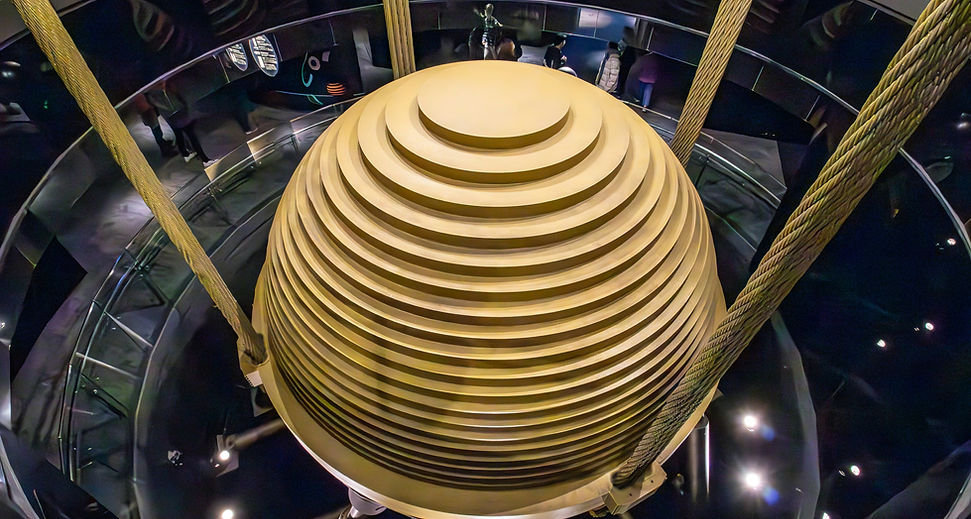
picture of Yash Savla
The Giant Pendulum
In addition to its foundation and core, Taipei 101 has another special feature. High winds or strong movements can cause the building to sway dangerously. To counteract this swaying, a gigantic pendulum was devised. A giant steel ball pendulum weighing 660 tons was developed (Tuned Mass Damper). The pendulum is designed to swing in the opposite direction in the event of sway. These countermovements sort of balance the two forces and ensure significantly lower movement. Hydraulic arms are fitted all around to prevent the pendulum from swinging too much, and to ensure that it can be controlled and locked in place if necessary. To increase the effectiveness of the lever effect, the pendulum was suspended between the 86th and 92nd floors. It still holds the record for the world's largest Tuned Mass Damper.
The Facade
Apart from the pendulum, the facade plays a very important role in wind conditions. A distinctive feature of Taipei 101 is its eight outward-angled sharp ending modules from the 26th to the 90th floor. These modules give the building a strategic advantage as well as a temple-like appearance. There are a total of eight, eight floor high modules. These modules offer the possibility of greatly reducing incoming wind. Instead of the wind hitting a flat façade, it is broken up. The wind then gets reduced step by step trhoughout the modules by the sharp edges.
For six years, it was the tallest building in the world until the Burj Khalifa surpassed it in 2010.
Nevertheless, Taipei 101 remains one of the architectural and engineering crown jewels of earthquake- and typhoon-safe skyscrapers to this day.
Firework show
